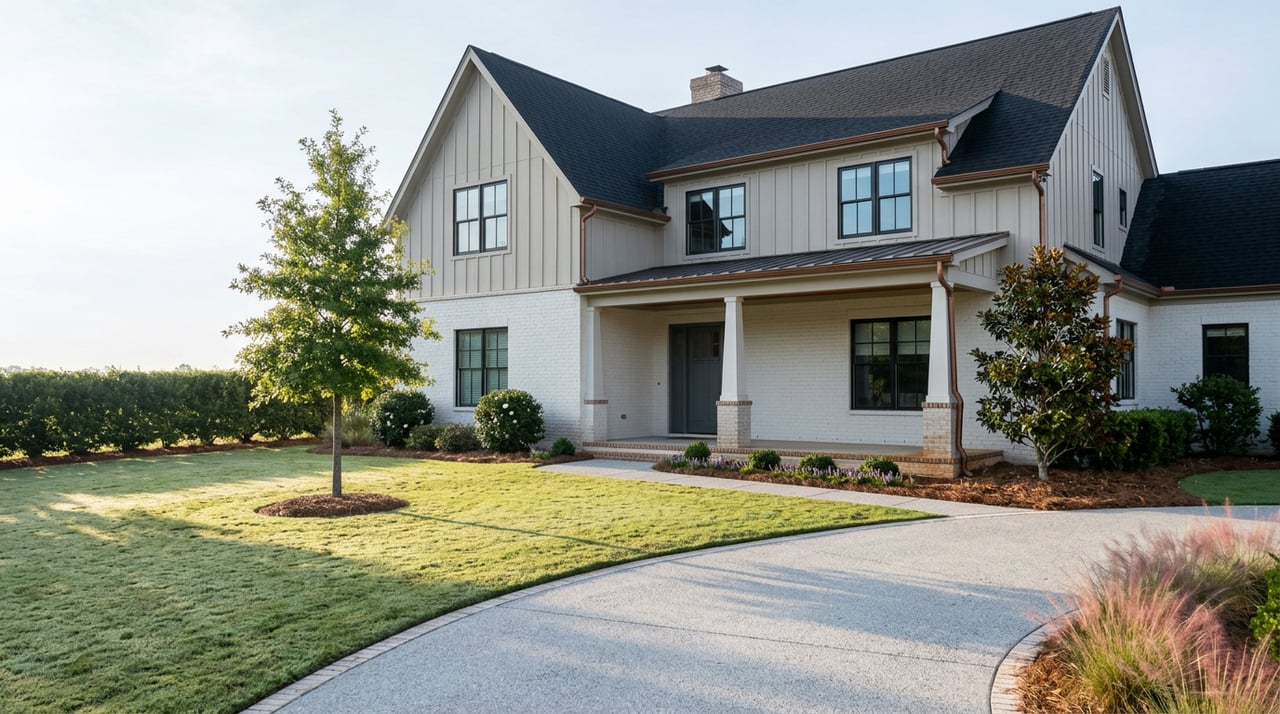
A "Wake Forest" Address Doesn't Always Mean a Wake Forest Tax Bill
September 17, 2026
September 17, 2026
Two homes, same price range, same 27587 zip code, same Wake Forest address on the sign out front. One owner pays close to $1,500 more a year in property taxes than the other. Neither home is nicer. Neither owner made a financing mistake. The difference comes down to a line most buyers never think to ask about: whether the parcel sits inside the Town of Wake Forest's actual corporate limits, or just outside them in what the town calls its extraterritorial jurisdiction.
That distinction rarely shows up on a listing sheet. The address says Wake Forest either way. But the tax bill, and whether you get to vote for the people who set that tax bill, depends entirely on which side of an invisible line your lot falls on.
Wake Forest has grown fast enough that its footprint no longer matches its identity. The town has expanded from roughly 30,000 residents in 2010 to more than 50,000 today, with projections pushing toward 70,000 within a decade. A lot of the housing built to absorb that growth sits in neighborhoods that carry the Wake Forest name and address but were never formally annexed into town limits.
Those neighborhoods are in what North Carolina calls the extraterritorial jurisdiction, or ETJ. The town's own planning rules and zoning apply there, same as inside the corporate limits. What doesn't apply is the town's tax rate.
Here is the math, using the town's and county's adopted rates for the fiscal year that ran from July 2025 through June 2026, the most recent figures on record. Inside Wake Forest's actual town limits, a homeowner pays the Wake County rate of 51.71 cents per $100 of assessed value plus the town's own municipal rate of 42 cents per $100, for a combined 93.71 cents per $100. On a $500,000 home, that works out to about $4,685.50 a year.
A home in the ETJ, just outside those same limits, pays no municipal rate at all. Instead it pays the county rate plus the Wake County Fire Tax District rate of 12.25 cents per $100, for a combined 63.96 cents per $100. On that same $500,000 home, the bill comes to about $3,198 a year. That is a gap of roughly $1,487 a year, or about $124 a month, for two houses that could sit across the street from each other.
You can already see this play out in current listing language. It is common to see Wake Forest homes advertised with a line like no city taxes to pay, usually meaning the property sits in the ETJ rather than inside town limits. It reads like a bonus. It is really a jurisdictional fact that buyers deserve to understand before they compare it against a similarly priced home a few streets over that does carry the town rate.
The tax line isn't the only thing that splits along this boundary. Voting does too.
If your property is inside Wake Forest's town limits, you vote for mayor and the Board of Commissioners, the people who set that 42-cent rate and decide how the town's budget gets spent. If your property is in the ETJ, you don't get a ballot in those elections, even though the town's zoning ordinance still governs what can be built next to you, what your setbacks are, and how your subdivision gets approved.
It is not a system designed to shortchange anyone. The logic goes back to a 1959 state law that let North Carolina cities regulate development just outside their borders, precisely because unregulated growth at the edge of a town tends to become the town's problem eventually anyway, through traffic, water and sewer demand, and the kind of chaotic buildout a municipality wants to avoid inheriting later. But from a buyer's chair, it means two households on the same cul-de-sac can have very different relationships to the same town, one paying into it and voting on it, the other bound by its rules with no direct say in them.
Here is where the timing actually matters for anyone shopping right now. In 2025, the North Carolina General Assembly passed a law that freezes ETJ expansion across all of Wake County. Under that law, no municipality in the county, Wake Forest included, can extend its extraterritorial jurisdiction beyond where it stood on January 1, 2025, and the freeze runs through December 31, 2028.
That means the ETJ boundary you see on a map today is the boundary you will be living inside or outside of for at least the next couple of years. A parcel that's ETJ now can't suddenly get pulled into a newly drawn ETJ zone. The lines are locked.
Annexation is a separate process from ETJ, and it isn't frozen. A property owner in the ETJ can still petition the town to be annexed into full town limits voluntarily, at which point the municipal tax rate and municipal voting rights both kick in. What the freeze does is remove one direction of change. The ETJ map can't grow through town action. It can only shrink, one voluntary annexation petition at a time, or hold exactly as it is.
There's a reason this isn't just a bureaucratic curiosity. Wake Forest's own Board of Commissioners has identified a capital infrastructure need of more than $530 million to keep pace with the town's growth, covering the roads, water, and sewer capacity that a population moving from 50,000 toward 70,000 residents will require.
That kind of number puts real pressure on the town's tax base. Every ETJ household enjoying town zoning benefits without paying the municipal rate is, in a narrow fiscal sense, a household the town would rather have inside its tax rolls. That doesn't mean annexation is coming for any specific neighborhood, and nothing in current policy forces it. But it does mean the incentive to court voluntary annexations, and to eventually revisit how growth gets paid for, isn't going away. A buyer weighing an ETJ home for its lower tax bill today is making a reasonable choice for today. Whether that gap holds steady for the next decade is a fair question to sit with, not a settled one.
Before you weigh one Wake Forest listing against another on price alone, it's worth confirming which side of this line each one falls on. A few practical steps:
None of this makes one status better than the other. Some buyers actively prefer the ETJ's lower combined rate and don't mind sitting out municipal elections. Others want the vote and are glad to pay for it. The point is knowing which one you're actually buying before you sign, not after your first tax bill arrives.
Can an ETJ property later become part of town limits? Yes, through voluntary annexation, which a property owner can petition for. It isn't automatic and isn't currently required by anything in the ETJ freeze.
Does ETJ status affect what I can build or renovate? Not in terms of Wake Forest's zoning and building rules, which apply the same way in the ETJ as inside town limits. What changes is who taxes you and who you vote for, not what the town allows you to build.
Will the ETJ freeze itself expire and let the map grow again? As written, the freeze runs through December 31, 2028. What happens after that date is a decision for a future legislative session, not something settled today.
Every one of these questions is easy to answer for a specific parcel. It just has to be asked before the offer goes in, not after closing.
If you're comparing Wake Forest listings and want a clear read on which side of the town line a specific property sits on, and what that means for your actual monthly cost, Judy Johnson can walk through the parcel with you before you write an offer. Let's Connect.
Stay up to date on the latest real estate trends.
Get assistance in determining current property value, crafting a competitive offer, writing and negotiating a contract, and much more. Contact Judy today to discuss all your real estate needs!